Extraterrestrial microorganisms
Serious MenExtraterrestrial microorganisms enter the story as cells recovered from the upper atmosphere, but their significance quickly exceeds the laboratory result: Arvind Acharya treats them as the first evidence of life arriving from space and as support for the idea that life on Earth began beyond it. The discovery is presented as a breakthrough, while its implications unsettle the distinction between the alien and the terrestrial.
The organisms and their discovery
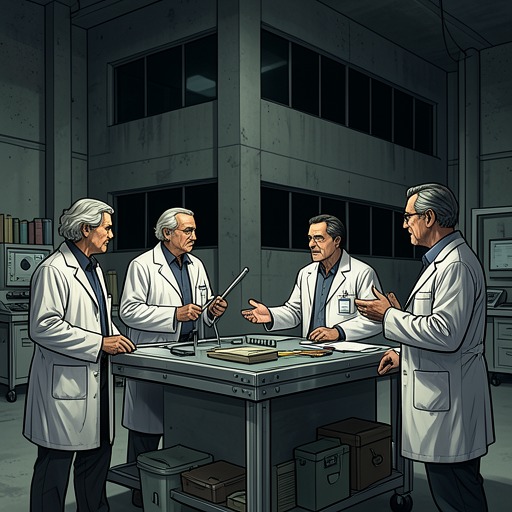
In the first week of November, Arvind Acharya’s balloon carried four samplers above Hyderabad to capture air. Three went to laboratories in Boston and Cardiff; the remaining sampler reached the Institute of Theory and Research, where Oparna Goshmaulik and her research team studied it with two American scientists. Their work was conducted in isolation from the rest of the Institute, and the results were not announced until Oparna emerged from the basement laboratory with the handwritten findings.
The report identified a rod-like bacillus and spores of the fungus Engyodontium albus de Hoog in material captured at an altitude of 41 kilometres. The Institute’s press briefing described the sampler as sterilized steel equipment opened by remote control at a chosen altitude, and emphasized that any life found so high would be coming down rather than rising from Earth. The finding was therefore not simply the detection of unfamiliar cells: their reported location was central to the claim that they might have an extraterrestrial origin.
From laboratory result to cosmic claim
The Institute’s announcement called the result an astonishing discovery and the closest anyone had come to finding aliens. In the novel’s narration, the result is treated as confirmation that beings were falling from the sky, and Acharya becomes the first person to discover aliens. The language moves decisively beyond the cautious possibility of the press briefing, making the microorganisms evidence for a cosmic account of life even as the terrestrial identity of the organisms remains difficult to separate from the alien one.
Acharya also connects the finding to the theory that microscopic organisms first brought life to Earth from space. The reported cells thus support a version of panspermia: life’s beginnings need not have been confined to Earth. The briefing extends the possibility to sudden-appearing diseases such as SARS, asking whether they too could be extraterrestrial in origin. That suggestion is raised as a question, not established as a result of the sampler analysis.
Public meaning and narrative significance
The discovery becomes public through a press release headed “EXTRATERRESTRIAL LIFE FOUND.” Acharya objects to the oversized, sensational typography but approves the rest of the release. His own remarks to the Press Officer turn the announcement into a comic image of long familiarity with alien life, capped by the suggestion that aliens used aliens to make curd. The joke makes the cosmic claim sound at once astonishing and domestic: the unknown may already be entangled with the ordinary.
The announcement also changes the Institute’s atmosphere. Calls spread through its rooms, senior scientists listen with fascination, younger researchers try to verify what they are hearing, and scientists make their way to Acharya’s office to congratulate him. The microorganisms matter, then, both as a scientific finding and as the trigger for a sudden institutional and public upheaval. By making cells at 41 kilometres legible as possible visitors from space, the episode turns a remote atmospheric sample into a challenge to humanity’s assumptions about where life begins and what counts as alien.